The concept of AI and its roles in Education
Meaning of Artificial Inteligence
Artificial Intelligence (AI) refers to computers or digital systems that can help us think, solve problems, and carry out tasks that normally need human effort. Think of AI as a very smart assistant fast, tireless, and good at recognising patterns.
Currently, AI is experienced in:
| Technology features: | How AI is Working |
|---|---|
| M-Pesa fraud alerts | Detecting unusual phone activity |
| Google Translate / Swahili translation | Understanding & generating language |
| Face unlock on smartphones | Recognising faces |
| YouTube / TikTok suggestions | Recommending content based on your interest |
| WhatsApp voice-to-text | Understanding speech |
Application of AI in the Classroom
AI does not replace teachers. Instead, it supports teachers just like chalkboards, projectors, or textbooks support learning.
| Teacher Activity | How AI Helps |
|---|---|
| Setting exam questions | Generate quizzes, multiple choice questions, marking rubrics |
| Lesson preparation | Suggest lesson plans and materials based on syllabus topics |
| Differentiation | Suggest activities for fast learners, slow-learners, or SEN learners |
| Assessment | Provide instant marking & feedback for basic quizzes |
| Language support | Translate instructions into Kiswahili/English |
| Admin | Draft letters, reports, and attendance messages to parents |
Think of AI as a digital teaching assistant — you are still the expert.
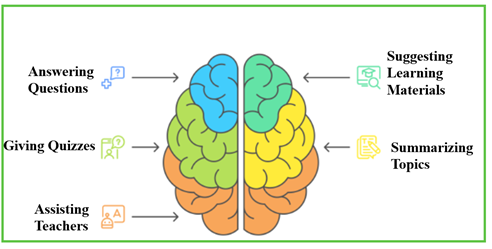
An AI prompt is the instruction, question, or message you give to an Artificial Intelligence system to guide it in generating a response. In simple terms, a prompt tells the AI what you want it to do and how you want it done.
Why Prompts Matter
AI does not “think” like humans. It responds based on patterns learned from data. A well written prompt:
Defines the task clearly.
Sets the format (e.g., essay, bullet points, code).
Specifies the audience (e.g., students, professionals).
Controls tone (formal, simple, academic, creative).
Limits length or scope.
Example of AI usage in lesson preparation
Topic: Photosynthesis (Form 2, Biology).
You can prompt an AI tool with: “Create a 35-minute Form 2 Biology lesson on Photosynthesis based on the TIE syllabus. Include a group activity and 5 assessment questions.”
AI can propose:
- Lesson plan & learning objectives.
- Simple notes & a diagram suggestion.
Five (5) Assessment Questions (5 Minutes).
Short homework task.
- Remember, You have to review, adjust, and localise any information obtained from AI for your learners and school context.
Even if only the teacher has a smartphone, AI can help:
- Explain tough concepts: “Explain mitosis for Form 3 students in simple Swahili.”
- Create revision questions: “Generate 10 chemistry practice questions with answers (NECTA style).”
- Support struggling learners: “Provide a short reading exercise for slow readers in Standard 4.”
- Help special needs learners: Use audio reading, simplified texts, or voice typing.
- Create flashcards: “Make English vocabulary flashcards for Standard 5 on ‘Weather’.”
One device + teacher creativity is enough to start.
However, AI can act as a Student Tutor (Guided by Teacher);
AI can provide extra practice in:
- Mathematics (step-by-step explanations).
- Reading & writing (paragraph feedback).
- Kiswahili & English grammar.
- Geography (maps, rainfall graphs).
- Biology (cell structure, respiration).
- Civics (rights & responsibilities).
Teacher guidance is essential to ensure accuracy and alignment to syllabus.
Limitations What AI Cannot Do (Yet)
- Sometimes gives wrong information (“hallucinations”).
- Lacks human judgement, empathy, and context.
- Can be biased depending on the data it was trained on.
- May not know the latest Tanzanian syllabus or local policies.
Therefore, teachers should always review, correct, and guide AI outputs.
Teacher’s Role in the AI Era
Teachers provide what AI cannot:
- Values & discipline.
- Real-world context.
- Motivation & encouragement.
- Classroom relationships.
- Cultural and ethical guidance.
AI + Teacher = Better learning | AI without a teacher = confusion and risk.
Training Activity: Turn a Current Lesson into an AI Assisted Plan.
- Pick a topic you will teach this week.
- Prompt AI: “Plan a 40-minute lesson including group work, local examples, and a 10-minute formative assessment.”
- Review, localise (add Tanzanian examples), and align with NECTA syllabus.
- Prepare delivery and simple assessment in class.
AI won’t take your job. Teachers who use AI wisely will lead the future of education.
AI is just “chalk for the digital classroom.” It doesn’t replace the teacher rather it makes the teacher more effective.