Resource 7: Practical Examples of ICT-Supported Approaches
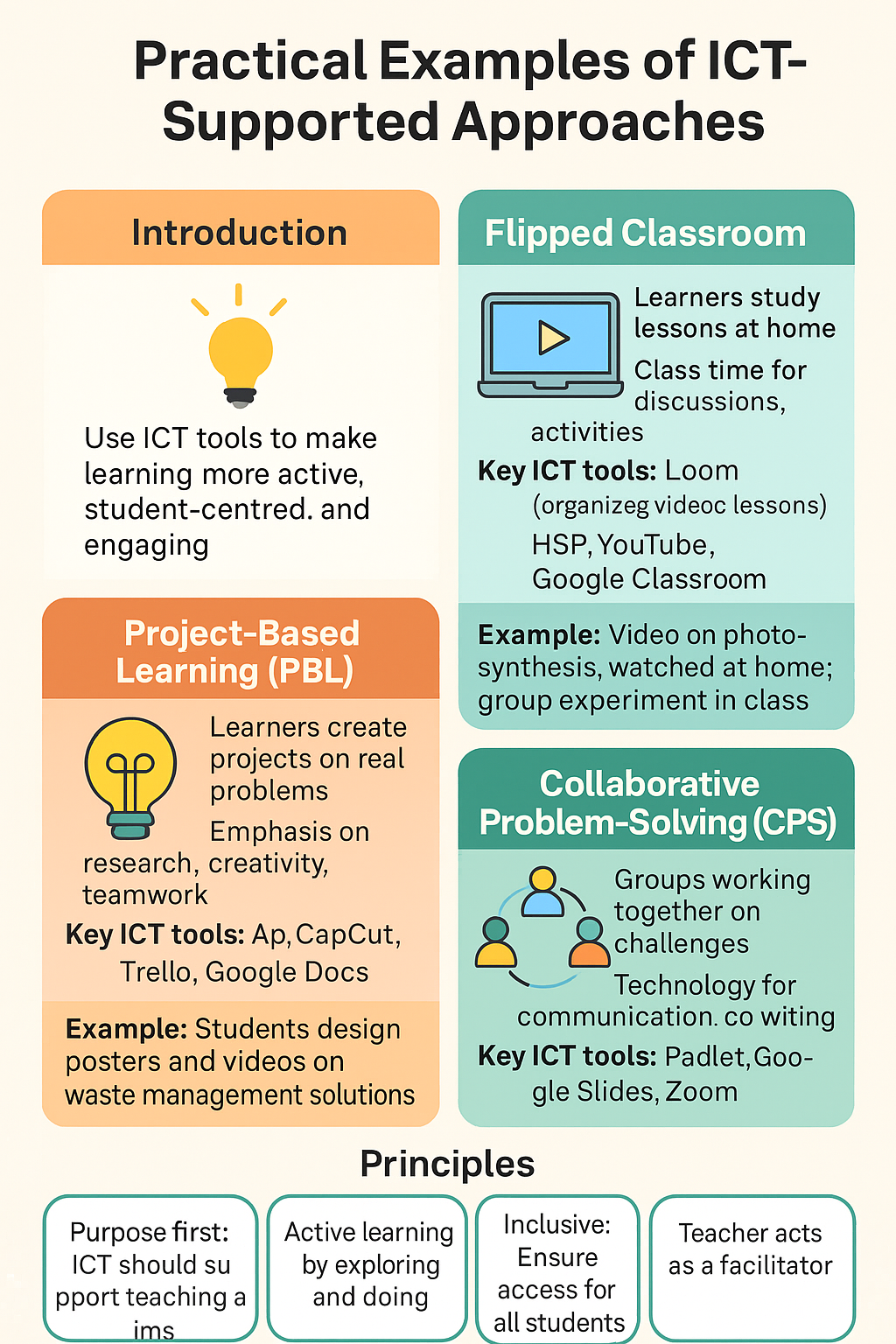
Practical ICT-Supported Approaches for Student-Centred Teaching
Progressive teaching means students learn by doing, discussing, investigating and creating — not just listening and copying. ICT helps make this shift practical, even with limited devices (e.g., one phone per group).
1) Flipped Classroom (watch first, apply in class)
How it works: Share a short video/reading before class (Loom, YouTube, WhatsApp, Google Classroom). Use class time for group work, experiments, debates, problem-solving.
Example: Photosynthesis — Learners watch a 7–10 min video and answer 3 H5P questions. In class, groups test how light affects leaves and present findings.
Why it works: Class time shifts from listening to thinking and doing.
2) Project-Based Learning (learn by solving real problems)
Tools: Google Docs / WhatsApp (planning), Canva/Slides (posters), CapCut/Recorder (videos)
Example: Waste in the community — Groups collect photos/interviews with phones, brainstorm solutions in Google Docs, design a poster in Canva (or paper poster photographed), then present to class/community.
Why it works: Students learn content through action, not memorising notes.
3) Collaborative Problem-Solving (think together with ICT)
Tools: Meet/Zoom (breakouts), Jamboard/Padlet (brainstorm), Google Slides (final output)
Example: Struggling small business — Groups discuss the case in breakout rooms, map causes/solutions on Jamboard, co-create a Slides deck and present.
Why it works: Learners negotiate, justify and refine ideas — key skills for life and work.
Pedagogical reminders when using ICT
- Start with the learning goal — then choose the tool.
- Plan for activity: inquiry, collaboration, projects, reflection.
- Design for equity: one device per group is enough.
- Teacher as facilitator, not only content deliverer.
- Assess both the process (collaboration, reasoning) and the product.
Quick planning template (try tomorrow)
| Step | Teacher does | Students do |
|---|---|---|
| Before class | Share a short video/reading (WhatsApp / Classroom) | Watch/read + answer 2–3 quick checks |
| In class | Give a problem/case; set roles; monitor | Investigate, discuss, create output (poster/slides/video) |
| End of class | Run a 3–5 item Kahoot/Mentimeter | Justify choices in pairs/groups |