Searching with AI
1. Meaning of AI and Examples
Artificial Intelligence (AI) is a branch of computer science that focuses on creating machines or software capable of performing tasks that normally require human intelligence. These tasks include learning, reasoning, problem-solving, understanding language, and recognizing patterns.
Examples of AI in everyday life and education:
(i) Virtual Assistants: Siri, Alexa, and Google Assistant respond to voice commands.
(ii) Chatbots: Online help systems that answer questions automatically.
(iii) Recommendation Systems: YouTube or Netflix suggesting videos based on your interests.
(iv) Smart Learning Platforms: AI-driven educational software like Khan Academy, Coursera, or Duolingo that adapt lessons based on learner performance.
(v) Automated Grading: AI tools that assess multiple-choice or even essay type answers.
2. What Makes AI Different from Search Engines?
Traditional search engines provide long lists of websites. For example, searching for photosynthesis notes Form Two Tanzania may return hundreds of results, many of which you need to evaluate manually. AI platforms such as ChatGPT, Google Gemini, or Microsoft Copilot work differently. They analyse information from many sources at once, summarise key ideas, refine unclear questions, and adapt explanations to your teaching level. This means teachers spend less time searching and more time preparing meaningful learning experiences.
3. Searching Learning Materials with AI Tools
Searching with AI involves using intelligent tools like Chat GPT to find information quickly by asking clear and specific questions.
Effective AI-based searching begins with crafting clear and purposeful prompts that specify what you want, the context, and any constraints such as format, level, or examples. Good prompts focus on clarity, specificity, and completeness for example, stating the target audience, expected output, and required depth. When necessary, users can refine their search by breaking complex queries into smaller tasks, using follow up prompts to narrow or expand the results, or requesting the AI to compare options. Proper technique also includes iterative improvement: reviewing the initial response, clarifying gaps, and prompting again to achieve the desired outcome.
The following are steps to follow during searching;
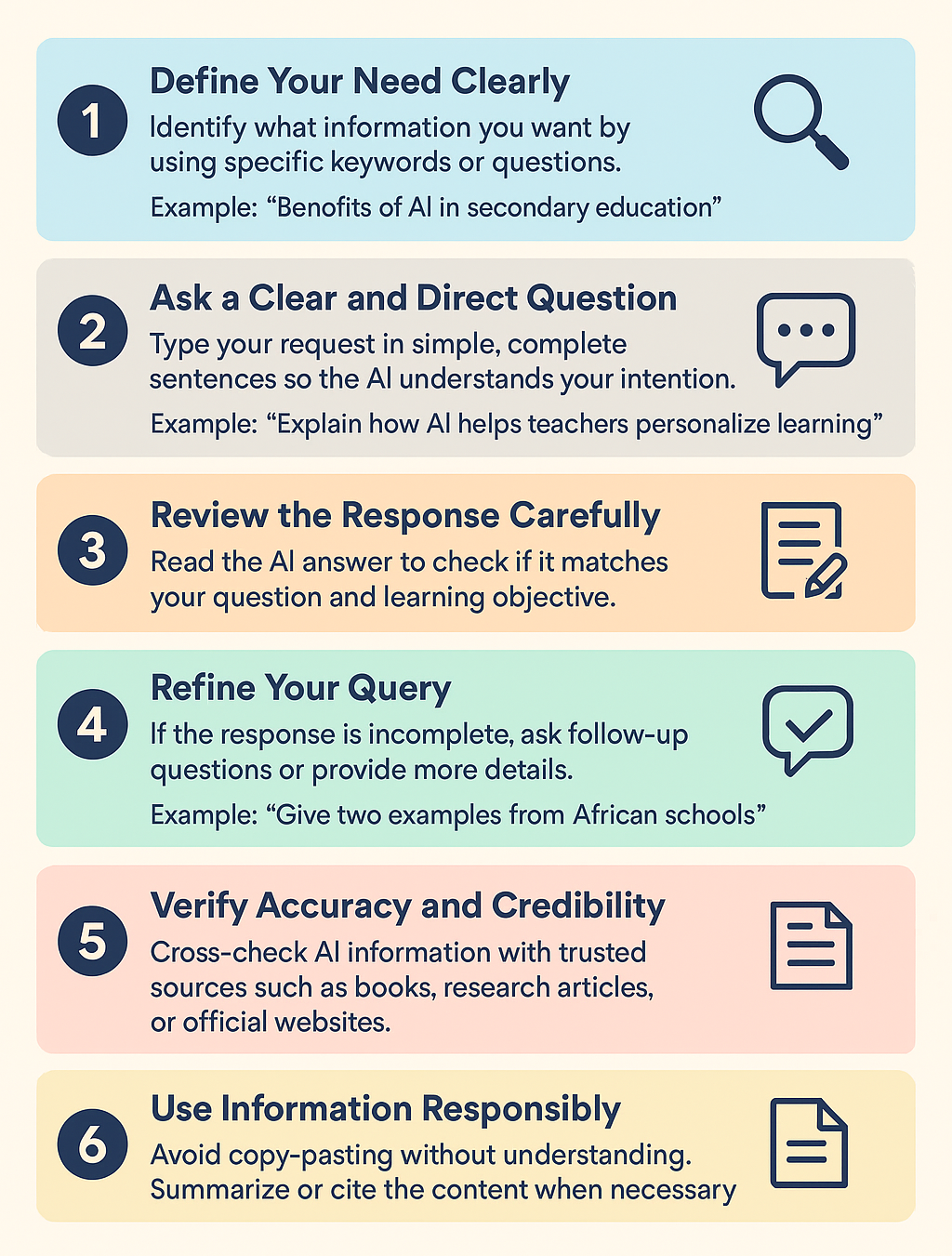
Before using AI-generated content, users must verify its relevance, accuracy, and quality by cross checking information against credible sources such as academic databases, government reports, or reputable institutions. Ensure that the content directly addresses your purpose, aligns with the current context, and reflects up to date facts. Evaluate accuracy by checking data, citations, logical consistency, and potential bias. Assess quality by looking at clarity, completeness, coherence, and adherence to professional or academic standards. Only after validating these elements should the generated content be adopted for teaching, research, or decision making.
4. Importance of AI in Education
AI has a growing impact on teaching and learning. Its importance includes:
(i) Personalized Learning: AI can adapt lessons to each student’s pace, strengths, and weaknesses.
(ii) Access to Resources: AI-powered search tools help teachers and students find relevant materials quickly.
(iii) Time-Saving for Teachers: Automates tasks such as grading, scheduling, and content creation.
(iv) Interactive Learning: AI simulations, virtual labs, and educational games make learning engaging.
(v) Data-Driven Insights: AI can analyze student performance and suggest interventions for improvement.
(vi) Supporting Inclusive Education: AI tools can assist learners with disabilities, for example, speech-to-text software or visual aids.
(vii) Curriculum aligned explanations: You can ask AI to explain a topic according to a specific class level. For example: “Explain heat transfer for the Form Two Physics syllabus in Tanzania.”
(viii) Simplifying difficult concepts: AI can break down complex ideas or provide examples connected to Tanzanian life, such as solar energy use in Dodoma or hydropower in Rufiji.
(ix) Generating teaching materials: AI can create quizzes, summaries, diagrams, classroom activities, or reading exercises tailored to your subject.
(x) Supporting evaluation: AI can help you judge whether a website is credible by applying tools such as the CRAAP Test.
(xi) Helping low resource settings: Even with limited bandwidth, text based AI tools can assist teachers in preparing lesson notes, chalkboard summaries, or assessments.
5. Things to Consider While Using AI to Search Learning Resources
When using AI tools for finding educational content, the following should be considered:
- Credibility of Sources: Ensure the AI retrieves information from trustworthy educational websites, research institutions, or official databases.
- Relevance: The AI should provide resources that match the learner’s level and learning objectives.
- Accuracy: Double check the information provided, as AI systems may sometimes give outdated or incorrect results.
- Ethical Use: Respect copyright laws and avoid plagiarism when using AI-generated content.
- Privacy and Security: Be cautious with platforms that require personal data.
- Critical Thinking: Use AI as a tool to supplement learning, not as a replacement for understanding concepts.
Artificial Intelligence (AI) is transforming education by providing personalized, interactive, and efficient ways to teach and learn. While AI can greatly support learning resource searches and lesson delivery, it is important to critically evaluate the information it provides and use it responsibly.